
The term "GTM Engineer" was coined by Clay in 2023, and it has since caught on at companies like Cursor, Lovable, and Webflow — as Clay writes on its own blog. According to ZoomInfo Pipeline (citing Bloomberry's analysis of 1,000 job postings), the number of open GTM Engineer positions grew 205% year over year, about 100 new postings are published each month, and salary ranges run from $85,000 for junior roles to $241,000 for senior ones. Bloomberry itself doesn't explicitly state the geography of the sample, but the figures are in dollars, and the employers mentioned include Vercel, OpenAI, Ramp, and Clay — so this is essentially about the US market.
What a GTM Engineer actually does
Clay's guide defines GTM engineering as "the practice of building automated revenue systems using AI, data, and workflow automation — instead of manually running go-to-market." The unit of work isn't a single task, but a system that operates at scale.
Clay describes three sequential layers of work:
- Data foundation — clean, deduplicated CRM records.
- Data modeling — scoring models, ICP attributes, research data.
- Data activation — data triggers concrete revenue actions (lead routing, personalized outreach, a campaign).
A practical example from Clay's guide: a workflow tracks funding-round signals, pulls the new company into Clay, enriches it with firmographic and contact data, scores it against the ICP, generates a personalized opening line via an LLM — and sends the best accounts to the CRM and an outbound sequence.
Apollo.io's description of the role identifies five areas of responsibility: data enrichment and quality control, scoring models, workflow automation (lead routing, sequence triggers), setting up AI agents for research and content generation, and analytics/dashboards.
What skills are needed
Clay puts it this way: a GTM engineer is a "hybrid: half commercially-minded person, half builder" (source). Production code isn't required — what's needed, per the guide's wording, is "a willingness to figure out a tool by poking at it" (source). At the same time, Apollo.io's list of technical skills names SQL, JavaScript/Python for custom integrations, working with APIs and data warehouses, CRM configuration, and prompt engineering for AI orchestration.
The stack Clay names: a CRM (Salesforce), a data warehouse (Snowflake/BigQuery), and an "engine" layer — Clay itself, which in one place covers enrichment, scoring, research, and activation.
It's not the same as a GTM Analyst
The names sound similar, but the roles are different — and the GTM Analyst role appeared much earlier. Based on a review of job postings by productroadmap.ai, a go-to-market (strategy) analyst works on market and buyer-behavior analysis, pricing and product positioning, competitive intelligence, and financial modeling — a strategic, research-oriented role with no code or automation. A GTM Engineer, by contrast, barely shapes strategy at all — they implement hypotheses that have already been decided, as working systems. Simplified: a GTM Analyst answers "what to do in the market," a GTM Engineer answers "how to automate it."
GTM Engineer vs RevOps
Before comparing the two — what RevOps is, in case you're hearing about this role for the first time. By Salesforce's definition, revenue operations is "a strategic framework that unifies all of a company's revenue activity": marketing, sales, customer success, and often finance operate on shared processes and a single technology stack instead of siloed departments with incompatible data and goals. In practice, a RevOps team consolidates revenue data, integrates CRM/marketing/ERP systems, automates routine work like handing a lead between departments or issuing invoices, and makes sure every revenue team is moving in the same direction. This is already an established, standard position at most B2B companies — unlike GTM Engineer, which only appeared in 2023.
This is the closest and most common comparison to GTM Engineer — many GTM engineers start out in RevOps. Clay frames the difference this way: "RevOps keeps the existing process running. GTM engineering changes the process itself." Salesforge.ai breaks it down along these axes:
| RevOps | GTM Engineer | |
|---|---|---|
| Starting point | Existing process: "what's blocking the funnel" | Blank slate: "what system to build" |
| Owns | Lead routing, SLAs, forecasting, process documentation | Data pipelines, stack architecture, API integrations, automation |
| Skills | Business operations, financial modeling, Salesforce/HubSpot, SQL for reporting | SQL, Python, API design, data engineering |
| Success metric | Funnel efficiency, SLA adherence, forecast accuracy | System uptime, integration reliability, data accuracy, automation coverage |
GTM Engineer vs Data Engineer vs Analytics Engineer
Here it's worth leaning on primary sources for these roles themselves, not just GTM engineering's own marketing.
Data Engineer. By Splunk's definition, a data engineer "designs, builds, and maintains scalable data systems and pipelines" that let a company collect, store, and process large volumes of data. Key areas: data architecture, collecting and validating data from various sources, process automation, infrastructure for data scientists and analysts. Tools: Python/Java/Scala/SQL, Hadoop/Kafka, cloud platforms, Airflow.
Analytics Engineer. The role took shape around 2018 in the community around dbt (then still Fishtown Analytics) — cloud warehouses (Redshift, BigQuery, Snowflake) and data-loading services (Stitch, Fivetran) made storage cheaper and extraction simpler, while business users increasingly lacked the skills to work with raw data directly. By dbt Labs' definition, an analytics engineer "provides clean datasets to end users by modeling data so that users can answer their own questions" — writing transformations (mostly in SQL via dbt), testing data, documenting and maintaining the warehouse's structure. The difference from a data engineer, per the same dbt post: a data engineer builds infrastructure and pipelines, an analytics engineer builds transformation and documentation on top of data that's already been collected.
GTM Engineer. Unlike both roles, the unit of work isn't a dataset or a pipeline, but an entire revenue system: from data to a concrete action (an email, a call, a CRM record) that moves a deal forward. A GTM engineer may use SQL and APIs the same way a data or analytics engineer does, but the end recipient of their work isn't an analyst or a dashboard — it's a sales/marketing process, and the metric isn't data quality on its own, but meetings and deals.
| Data Engineer | Analytics Engineer | GTM Engineer | |
|---|---|---|---|
| What it builds | Data pipelines and infrastructure | Transformations and clean datasets on top of the warehouse | Automated revenue workflows |
| For whom | Data scientists, analysts, the whole company | Business users, self-service BI | Sales, marketing, RevOps |
| Main tool | Airflow, Spark/Hadoop, cloud warehouses | dbt, SQL | Clay, CRM, API integrations, LLMs |
| Metric | Data reliability and availability | Dataset quality and documentation | Pipeline, meetings, deals |
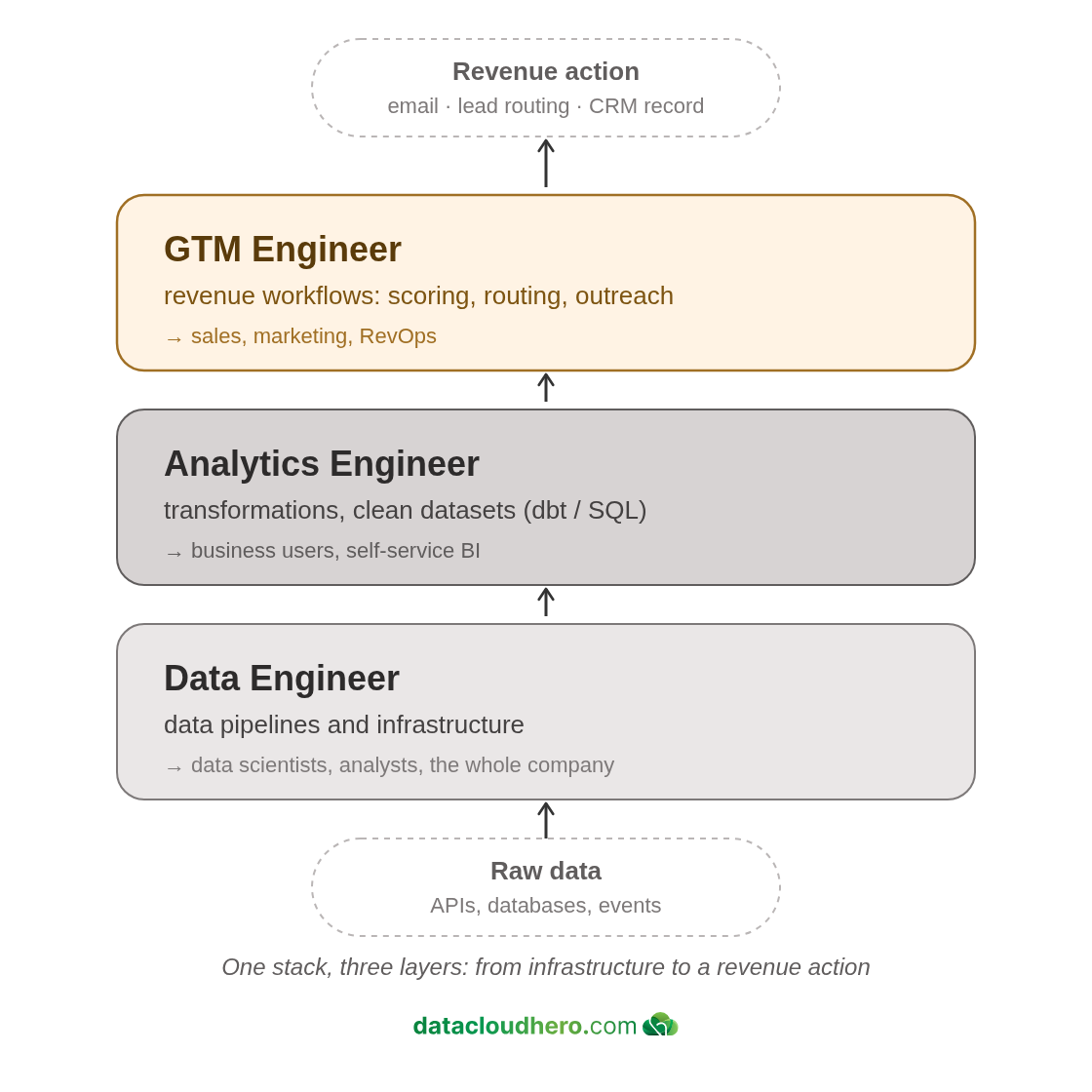
In short
GTM Engineer isn't a replacement for a data or analytics engineer, and it isn't "more technical" — it's functionally a version of RevOps oriented toward speed and revenue impact: it uses the same toolset (SQL, APIs, data models) as engineering roles in data, but the product of the work isn't a dataset — it's a working piece of the go-to-market process. The role is young (2023) and not yet standardized the way data/analytics engineering are — so a GTM engineer's actual scope of work varies a lot by company, unlike the much more established data and analytics engineer roles.
Sources: Clay — GTM Engineering (blog), Clay — The Complete Guide to GTM Engineering, Apollo.io — GTM Engineer Job Description, ZoomInfo Pipeline — What Is GTM Engineering?, Salesforge.ai — GTM Engineering vs RevOps, Salesforce — What Is Revenue Operations (RevOps)?, productroadmap.ai — What Is a Go-To-Market Strategy Analyst Job Description?, dbt Labs — What is analytics engineering?, Splunk — The Data Engineer Role, Explained.